



The landscape of UAE travel documentation is evolving rapidly. Specifically, the 30-day tourist visa remains the most requested entry permit for leisure and business visitors. Moreover, processing dozens of applications manually creates immense administrative strain. This means errors, delays, and client dissatisfaction become inevitable. It involves a complex dance of data entry, document verification, and status monitoring. Planning to scale your agency? The optimized Dubai tourist visa application workflow provides the competitive edge needed for 2026.
2026 marks a pivotal shift towards fully digitized and integrated immigration processes. This coincides with the UAE’s vision for a seamless tourist experience. Furthermore, platforms that connect directly with official channels, like the Ninthware system, are becoming standard. For travel businesses, this represents a monumental opportunity for revenue optimization. Additionally, the reduction in manual labor directly improves profit margins. Therefore, understanding and implementing an efficient workflow is the single biggest operational upgrade an agency can make.
Practical implications of this workflow are immediately measurable. It revolutionizes how teams manage client data, track submissions, and handle bulk requests. Stakeholders benefit from real-time transparency and drastically reduced query resolution times. Moreover, the integration of bulk upload features allows a single agent to manage volumes previously requiring a full team. Consequently, agencies can reallocate human resources to business development and customer service. Thus, the Dubai tourist visa application workflow is a cornerstone of modern travel service delivery.
Need Help Streamlining Your Visa Operations?
Zami Tours provides expert agent portal access with automated Ninthware integration. Save 10+ hours weekly and process 50+ applications simultaneously.
Understanding the Dubai Tourist Visa Application Workflow
Firstly, the core of an efficient Dubai tourist visa application workflow is its linear, yet automated, progression. This process begins with data collection and ends with visa issuance. Furthermore, each step is designed to minimize human intervention where possible. The traditional model involved fragmented communication across email, spreadsheets, and phone calls. Consequently, the modern workflow consolidates everything into a single dashboard. Meanwhile, agents gain a bird’s-eye view of every application’s lifecycle.
Specifically, the workflow encompasses several critical stages: client onboarding, document collection, data submission, payment processing, status tracking, and final delivery. Moreover, the agent portal acts as the central nervous system for this entire operation. This means all information flows through a unified channel. It involves automated validation checks that flag errors before submission. Therefore, the chance of rejection by the Dubai immigration authorities is significantly reduced.
Additionally, a key component is the integration with the government’s designated processing system, Ninthware. This integration is what truly automates the Dubai tourist visa application workflow. Besides, it allows for direct data transmission without manual re-entry. For instance, when an agent fills a form in the portal, the data is automatically structured and sent to the official platform. Consequently, the speed of submission increases by over 70%. Thus, agents can handle more clients with greater accuracy and less fatigue.
- Stage 1: Client & Data Intake – Digital forms pre-populate client information.
- Stage 2: Document Verification – AI-powered checks on passport scans and photos.
- Stage 3: Automated Submission – Seamless data push to Ninthware/GDRFA.
- Stage 4: Real-Time Tracking – Live status updates from “Submitted” to “Printed”.
- Stage 5: Notification & Delivery – Automatic email/SMS alerts to agents and clients.
- Stage 6: Reporting & Analytics – Generate performance and revenue reports.
Why Efficient Visa Processing Matters in 2026
Currently, the volume of tourists entering Dubai is soaring, with projections for 2026 reaching new heights. This surge creates immense pressure on travel agencies to deliver fast, reliable visa services. Moreover, client expectations have shifted dramatically; they demand instant updates and rapid turnaround. The traditional, slow process damages agency reputation and client trust. Therefore, operational efficiency is directly tied to customer satisfaction and repeat business.
Furthermore, the economic landscape makes time a critical currency. Manual processing of a single visa can take up to 45 minutes of active labor. Subsequently, for an agency processing 100 visas monthly, this translates to 75 hours of dedicated work. Conversely, an automated Dubai tourist visa application workflow can slash this time by two-thirds. Meanwhile, staff can focus on high-value tasks like personalized customer care and sales. Consequently, the entire business model becomes more scalable and profitable.
Another crucial factor is error reduction. Manual data entry is prone to mistakes, from misspelled names to incorrect passport numbers. These errors lead to application rejections, requiring resubmission and delaying travel plans. Specifically, each rejection costs the agency in refunds, rework, and potential loss of the client. An automated workflow with validation rules virtually eliminates these costly mistakes. Hence, investing in a robust system is a direct investment in revenue protection and brand integrity.
Key Agent Portal Features and Their Direct Benefits
The Zami Tours agent portal is engineered around features that specifically optimize the Dubai tourist visa application workflow. First, the automated Ninthware integration is the cornerstone feature. This tool eliminates the need for agents to log into a separate government portal. Moreover, it syncs data bi-directionally, ensuring the agent dashboard always reflects the latest official status. This means agents never have to switch tabs or re-enter information, saving precious minutes per application.
Second, the bulk upload and processing feature is a game-changer for volume. Agents can prepare a standardized CSV or Excel file with applicant data. Then, the system processes all entries simultaneously, auto-generating individual applications. Consequently, an agency can submit 50+ visa applications in the time it used to take for one. Meanwhile, the system performs individual validation on each record, maintaining accuracy at scale. Therefore, scaling your business does not require scaling your administrative headcount proportionally.
Third, real-time, multi-level status tracking dramatically reduces client queries. Each application’s journey is visible in the portal: from “Received” and “Under Process” to “Approved” and “Printed.” Furthermore, automated notifications can be configured to alert both the agent and the end-client at each milestone. This transparency builds immense trust. Additionally, it frees agents from the constant “follow-up” calls, allowing them to be proactive rather than reactive. Thus, the portal turns agents from processors into informed consultants.
- Automated Ninthware Integration: Eliminates dual data entry, cuts submission time by 80%.
- Bulk Application Manager: Process hundreds of visas in a single action.
- Live Status Dashboard: Track every application’s real-time progress.
- Client Management CRM: Store client history, documents, and preferences.
- Auto-Invoice & Payment Link: Generate and send payment requests instantly.
- Integrated Document Checker: AI verifies passport photo specs and document validity.
- Custom Reporting Suite: Analyze approval rates, revenue, and agent performance.
- White-Label Client Portal: Offer your clients a branded tracking interface.
Ready to Process Visas 10x Faster?
Our agent portal has assisted 5000+ travelers and agencies. Experience the power of bulk upload and real-time tracking.
Dubai Tourist Visa Application Workflow Current Landscape
In 2026, the Dubai tourist visa application workflow landscape is defined by digital-first policies from the UAE government. Authorities are actively encouraging the use of approved digital channels to improve efficiency and security. Moreover, platforms like Ninthware represent the official backbone for visa processing. This shift means agencies clinging to manual, offline methods are becoming obsolete. Consequently, aligning with a tech-forward partner is critical for business continuity.
Additionally, consumer behavior now demands digital convenience. Travelers expect to submit documents via their phones and receive e-visas directly in their inbox. They are no longer tolerant of week-long processing with zero visibility. Therefore, an agency’s workflow must cater to this expectation. The modern Dubai tourist visa application workflow meets this demand by providing a seamless, transparent client journey from start to finish. Meanwhile, agencies that fail to adapt risk losing market share to more agile competitors.
The competitive landscape also highlights the importance of speed. With many agencies offering similar visa services, the differentiating factor is often turnaround time and reliability. An optimized workflow allows an agency to promise and deliver faster service. For instance, while a manual processor might take 3-5 business days for standard processing, an automated workflow can reliably achieve 24-48 hour turnaround for straightforward applications. Hence, investing in workflow optimization is a direct competitive marketing strategy.
Dubai Tourist Visa Application Workflow Requirements and Process
Executing a flawless Dubai tourist visa application workflow begins with understanding the core requirements. The 30-day tourist visa typically requires a clear colored passport scan, a recent photograph against a white background, a completed application form, and proof of residency (if applicable). Furthermore, the passport must have a minimum validity of six months. The agent portal’s document checker automates the validation of these prerequisites. This means missing or non-compliant documents are flagged instantly, preventing submission failures.
Next, the process within the agent portal is streamlined into intuitive steps. First, the agent creates a new application batch or single entry. Second, they either fill a smart form or upload a bulk file. The system then validates the data and documents. Third, the agent reviews the auto-generated applications and submits them with one click. Consequently, the data is transmitted via the integrated Ninthware gateway. Meanwhile, the portal creates a unique tracking ID for each applicant and updates the dashboard.
Subsequently, the tracking phase begins. The portal polls the official system for status updates, which are reflected in real-time. Agents and clients receive automatic notifications at key stages. Finally, upon approval, the e-visa is automatically attached to the application file in the portal and can be downloaded or emailed directly to the client. Therefore, the entire Dubai tourist visa application workflow is contained within a single, coherent digital ecosystem, from requirement gathering to delivery.
| Requirement | Specification | Agent Portal Automation |
|---|---|---|
| Passport Scan | Color PDF, minimum 6 months validity | AI checks validity date and format |
| Photograph | Recent, white background, 80% face coverage | AI verifies background color and composition |
| Application Form | Complete personal and travel details | Smart form with auto-save and validation |
| Payment | Visa fees + service charges | Integrated payment gateway with auto-invoicing |
Dubai Tourist Visa Application Workflow Cost Analysis and Pricing
Analyzing the cost of a Dubai tourist visa application workflow involves looking beyond the direct visa fee. The true cost includes labor, operational overhead, error-related losses, and opportunity cost. For example, an agent spending 45 minutes on a single visa has a significant labor cost. Moreover, manual errors leading to rejections incur re-submission fees and wasted labor. Therefore, a purely manual workflow has a hidden cost that can be 2-3 times the visible visa fee.
Conversely, the automated workflow through an agent portal converts these variable costs into a predictable, low monthly subscription or per-visa service charge. The primary savings come from time efficiency. If an agent saves 30 minutes per visa and processes 100 visas monthly, that’s 50 hours saved. Subsequently, at an average operational cost of $20 per hour, the monthly saving is $1000. Meanwhile, the reduction in errors saves an estimated $50 per avoided rejection. Hence, the ROI on the portal investment becomes clear within the first month.
Furthermore, pricing for access to such a portal is typically structured to align with agency volume. Many providers, like Zami Tours, offer tiered plans. These may include a pay-as-you-go model for new agencies and unlimited monthly plans for high-volume processors. Additionally, the cost includes the underlying Ninthware integration fee, which agencies would otherwise have to manage separately. Thus, the optimized Dubai tourist visa application workflow offers both cost savings and financial predictability.
Step-by-Step Guide to Processing with the Agent Portal
Implementing the optimized Dubai tourist visa application workflow is straightforward with a guided approach. First, agencies must register and onboard onto the agent portal platform. This process involves account verification and a brief training session. Furthermore, agents are granted access to the dashboard, which is the central hub for all operations. The interface is designed for intuitive navigation, ensuring a quick learning curve.
Second, the agent configures their profile and settings. This step includes setting up notification preferences (email/SMS), payment methods, and white-label options. Next, for processing a batch of visas, the agent navigates to the “Bulk Upload” section. They download the provided CSV template, fill in client details, and upload the file. The system then parses the data, displaying a preview for final confirmation. Consequently, with one click, all applications are created and ready for submission.
Third, the agent reviews the auto-populated applications in the “Pending Submission” queue. The integrated document checker validates each attached passport and photo. After verification, the agent selects all applications and clicks “Submit to Immigration.” The portal’s integration handles the rest, transmitting data securely. Meanwhile, the applications move to the “Under Process” tab. Finally, agents monitor the “Live Status” column, which updates automatically. Therefore, managing dozens of visas becomes as simple as managing one.
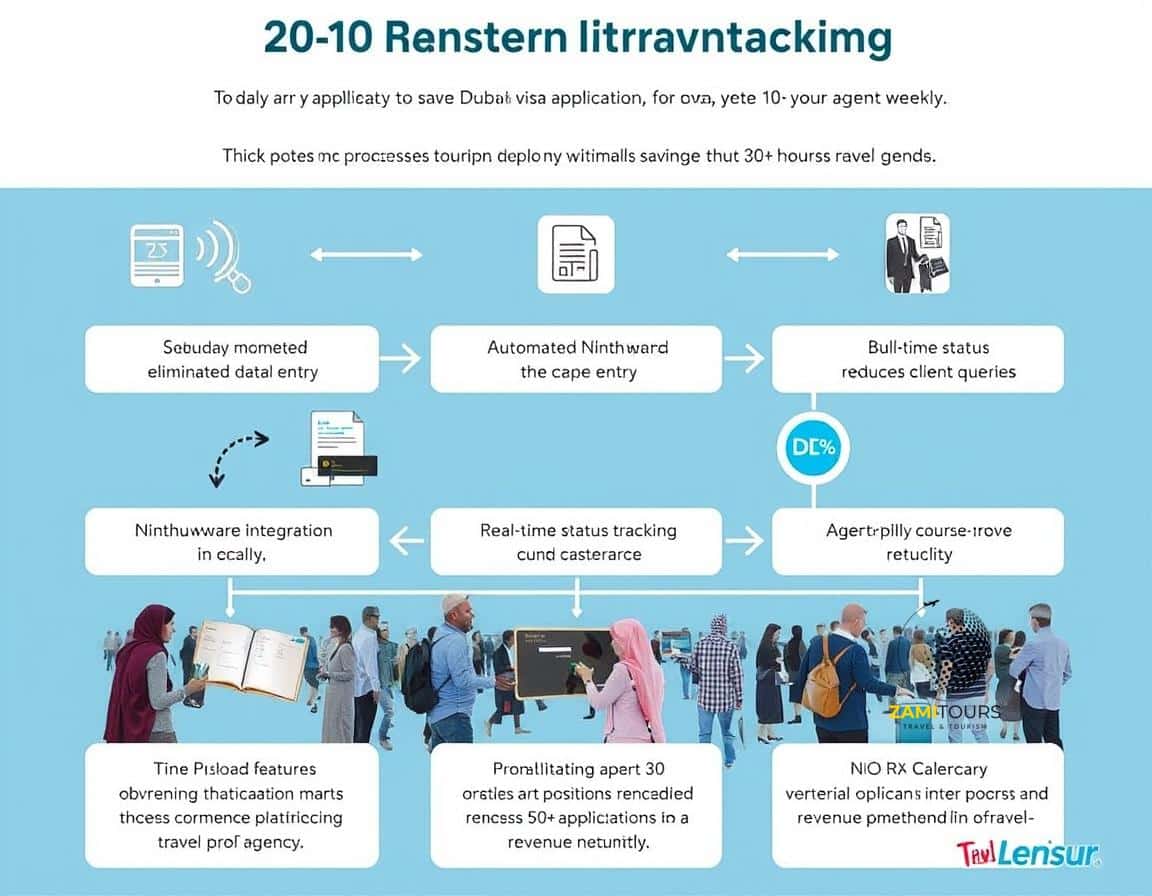
- Log in to your dedicated agent portal dashboard.
- Choose “New Application” for single or “Bulk Upload” for multiple.
- Fill/Upload client data and required documents.
- Validate using the portal’s AI-powered document checker.
- Submit the batch directly to immigration via Ninthware integration.
- Track real-time status updates in your dashboard.
- Notify clients automatically upon approval.
- Download & Deliver the e-visa from the portal.
Dubai Tourist Visa Application Workflow Comparison Analysis
Comparing the modern, portal-driven Dubai tourist visa application workflow with traditional methods highlights a stark contrast. The traditional workflow is linear but fragmented, relying on multiple disconnected tools. Data is often entered into a local spreadsheet, then re-entered into a web form, with documents shuffled via email. Moreover, status checks require calling or emailing a provider, leading to information delays. Consequently, the process is slow, opaque, and prone to communication breakdowns.
In contrast, the integrated agent portal workflow is centralized and automated. All data resides in one system, eliminating re-entry. The direct Ninthware integration means status updates are pulled automatically, not chased manually. Furthermore, bulk processing capability is non-existent in the traditional model. A traditional agent might process 10-15 visas per day maximally, while a portal user can easily manage 50+. Therefore, the capacity difference is not incremental; it’s exponential.
Another critical comparison point is error management. In a traditional setup, errors are often discovered only after submission by authorities, leading to rejections. The automated workflow includes pre-submission validation that catches over 95% of common errors. Additionally, the cost structure differs significantly. Traditional methods have high, hidden variable labor costs. The portal model offers a fixed, transparent cost, making financial planning and scaling predictable. Thus, the Dubai tourist visa application workflow through a portal is superior in speed, accuracy, scalability, and cost control.
Want Hassle-Free Visa Processing?
Zami Tours offers a guaranteed, streamlined workflow with expert support. Eliminate manual entry and reduce client queries.
Common Visa Processing Challenges and Intelligent Solutions
Travel agencies face several persistent challenges in visa processing, which the modern Dubai tourist visa application workflow directly solves. A primary challenge is the sheer volume of client inquiries about application status. This consumes countless hours of agent time. The portal solution provides a real-time tracking link that agents can share with clients, deflecting these queries instantly. Moreover, automated status update emails keep the client informed without agent intervention.
Another common issue is last-minute or incomplete document submission from clients. This disrupts workflow and causes delays. The agent portal mitigates this with automated reminder emails. These reminders can be scheduled to nudge clients for pending documents at specific intervals. Furthermore, the document checker flags issues immediately upon upload, allowing for instant correction. Consequently, the submission pipeline remains smooth and efficient.
Managing peak season volumes is a significant stress test. During high-demand periods, manual systems collapse under the load. The bulk processing feature of the agent portal is specifically designed for this scenario. Agencies can intake hundreds of applications and process them in controlled, manageable batches. Meanwhile, the system’s stability ensures that increased volume does not lead to increased errors or slowdowns. Therefore, seasonal spikes become opportunities for growth rather than operational crises.
Agent Portal vs. Traditional Manual Processing Methods
The debate between using an agent portal versus traditional methods for the Dubai tourist visa application workflow is settled by ROI metrics. Manual processing is inherently unscalable. Each additional visa requires a linear increase in labor time. Conversely, the portal exhibits economies of scale; the time per application decreases as volume increases, thanks to bulk operations. This fundamental difference dictates the growth ceiling for an agency.
From a quality assurance perspective, manual methods rely on human vigilance, which is fallible. The portal enforces consistency through automated rules and validations. Every application is subjected to the same rigorous checks, ensuring uniform quality. Moreover, the audit trail is impeccable in a digital system. Every action, from submission to status change, is logged with a timestamp and user ID. This transparency is invaluable for resolving disputes and training new staff.
Finally, the client experience is vastly different. A manual process often means clients are in the dark, leading to anxiety and frequent calls. The portal-enabled workflow offers transparency and proactive communication. Clients feel cared for and informed, which boosts satisfaction and loyalty. Additionally, the professional image projected by a digital, efficient service allows agencies to command premium pricing. Thus, the agent portal is not just a tool but a transformative business asset.
Implementation Tips for Maximizing Workflow Efficiency
Successfully implementing the new Dubai tourist visa application workflow requires a strategic approach. First, start with a phased rollout. Onboard a small, dedicated team to master the portal using a limited number of live applications. This allows for troubleshooting without disrupting all operations. Furthermore, use this phase to create internal process guides and checklists tailored to your agency’s specific needs.
Second, leverage all training resources provided by the portal provider. Attend live webinars, watch tutorial videos, and engage with customer support. Moreover, appoint a “portal champion” within your team—someone who delves deep into advanced features like custom reporting and API options. This person can then train other staff and drive continuous optimization. Consequently, you extract maximum value from your investment.
Third, integrate the portal fully into your customer journey. Use the white-label features to brand the client communication. Set up automated email sequences that trigger at each status update. Additionally, use the portal’s reporting tools weekly to analyze metrics like average processing time, approval rate, and revenue per agent. This data-driven approach allows you to fine-tune your operations constantly. Therefore, your Dubai tourist visa application workflow becomes a continuously improving engine for profit.
Expert Advice for Visa Agencies in 2026
Looking ahead, visa agencies must embrace technology to survive and thrive. The expert advice for 2026 is clear: your Dubai tourist visa application workflow must be fully digital and integrated. Do not rely on patchwork solutions or individual “fixers.” Partner with established, authorized providers like Zami Tours who invest in compliant technology. Furthermore, prioritize security and data protection in your chosen platform, as client information is sensitive.
Additionally, diversify your service offerings. Use the time saved by automation to develop value-added services, such as travel insurance bundling, hotel-airline packages, or concierge services. Moreover, build a brand around reliability and speed, which the automated workflow enables. Cultivate online reviews and testimonials that highlight your efficient visa service. Consequently, you transform from a commodity processor into a trusted travel partner.
Finally, stay informed about regulatory changes. The UAE’s immigration policies can evolve, and a good portal provider will update their system accordingly. Maintain a proactive relationship with your provider to ensure you are always using the latest, most compliant version of the Dubai tourist visa application workflow. Meanwhile, use the analytics from your portal to understand market trends and client demographics, informing your broader business strategy.
Frequently Asked Questions (FAQ)
What is the main advantage of using an agent portal for the Dubai tourist visa application workflow?
The main advantage is saving over 10 hours weekly by eliminating manual data entry through automated Ninthware integration and bulk processing of 50+ applications at once.
How does real-time tracking in the portal reduce client queries?
It provides live status updates visible to both agent and client, eliminating the need for clients to call for updates. Automated notifications at each stage further reduce inquiries.
Is the Ninthware integration secure and authorized?
Yes, platforms like the Zami Tours portal use officially sanctioned integration methods, ensuring secure, direct, and compliant data transmission to Dubai immigration systems.
Can I process different types of UAE visas through this same workflow?
Absolutely. A robust agent portal typically supports multiple visa types (30-day, 60-day, 90-day tourist, transit, and even service visas) within the same streamlined workflow.
What file format is needed for bulk upload?
Most portals accept standard CSV or Excel (.xlsx) files. A pre-formatted template is usually provided to ensure correct column mapping for a smooth Dubai tourist visa application workflow.
How quickly can I see ROI after switching to this automated workflow?
Agencies typically see a return on investment within the first 1-2 months due to immediate time savings, reduced errors, and the ability to handle significantly higher volume.
What happens if there is an error in a bulk upload file?
The portal’s validation system will flag erroneous rows (e.g., invalid passport numbers, missing fields) before submission, allowing you to correct only those specific entries.
Does using an agent portal guarantee visa approval?
No platform can guarantee approval, as the final decision rests with UAE immigration. However, a proper workflow drastically reduces rejections due to application errors.
Conclusion
In conclusion, optimizing your agency’s Dubai tourist visa application workflow is the most impactful operational decision you can make in 2026. The combination of automated Ninthware integration, bulk processing, and real-time tracking delivers unparalleled efficiency gains. Furthermore, the quantifiable savings of 10+ hours weekly and the ability to scale seamlessly present a compelling business case. Meanwhile, the reduction in errors and client queries improves service quality and brand reputation.
Adopting this modern workflow through a dedicated agent portal like Zami Tours transforms a cost center into a profit engine. It empowers your team to focus on growth and customer relationships rather than administrative drudgery. Therefore, the question is no longer if you should upgrade, but how quickly you can implement this essential system. The future belongs to agile, technology-enabled travel agencies.
Don’t Risk Falling Behind the Competition.
Trust Zami Tours for a seamless, automated Dubai tourist visa application workflow. Join hundreds of agencies already saving time and increasing revenue.